





Viral routines average 11 irritating actives, yet only 26% include sunscreen (Pediatrics, 2025). Dermatologists say 4 steps is enough. Here's what works.
Do You Really Need a 10-Step Skincare Routine? (No — Here's Why)

In June 2025, researchers at Northwestern Medicine published something uncomfortable in *Pediatrics*: the most-viewed skincare routines on TikTok averaged six products and 11 active ingredients with known irritation and allergy risk — and only 26% of the daytime routines included sunscreen ([Northwestern Medicine], 2025).
Read that again. The routines millions of people copy contain almost a dozen potential irritants and usually skip the one step dermatologists agree on most.
If you've ever felt behind because your shelf doesn't hold an essence, an ampoule, and three serums, this article is for you. We'll look at where the "more steps = better skin" myth came from, what stacking products actually does to your skin, and the four steps the evidence keeps pointing back to. One disclosure up front: we're a skincare brand telling you to buy fewer products. That's an argument against our own revenue, which is exactly why we think you should hear it.
Key Takeaways
- More steps don't mean better skin. Viral routines averaged 11 irritation-risk active ingredients, and only 26% included daytime sunscreen (Pediatrics / Northwestern Medicine, 2025).
- Consistency beats complexity: people believe they're 80–90% consistent with topical routines, but electronic monitoring shows real adherence closer to 40% (JAAD).
- The dermatologist core is 3–4 steps: gentle cleanser, optional hydrating toner, moisturiser, and SPF 30+.
- Add new actives one at a time, and only after 6–8 stable weeks on the basics.
Where Did the 10-Step Routine Myth Come From?
The 10-step routine is marketing momentum, not dermatology. It began as a 2010s retail framing for K-beauty product categories, then social media inflated it into a perceived baseline. Meanwhile, consumers moved the other way: global skincare sales reached roughly US$181 billion by 2025 as "skinimalism" — fewer, better products — became the dominant buying trend ([Euromonitor], 2024).
The incentives behind the myth aren't hard to trace. An influencer demonstrating 10 products has 10 affiliate links. A brand selling a "complete system" sells seven units instead of one. "Shelfie" culture turned product count into a status display. None of that says anything about what your skin needs.
Here's the part that rarely gets said: most people never bought into it. A 2025 YouGov survey of UK consumers found 39% follow a 1–3 step routine, 11% use 4–7 steps, and only 3% use eight or more ([YouGov], 2025). The maximalist routine is loud online and rare in real bathrooms.
CITATION CAPSULE: The 10-step skincare routine is a minority behavior, not a norm. YouGov's 2025 UK survey found 39% of consumers use a 1–3 step routine and only 3% use eight or more steps, while Euromonitor data shows global skincare's shift toward "skinimalism" — fewer, more effective products — within a market worth roughly US$181 billion by 2025 (YouGov, 2025; Euromonitor, 2024).


Can Too Many Skincare Products Actually Harm Your Skin?
Yes — and this is documented, not theoretical. Frequent use of multiple cosmetic products is a recognized risk factor for contact dermatitis ([Annals of Allergy, Asthma & Immunology], 2020). Every additional product adds new ingredients your skin has to tolerate, and stacking actives multiplies the irritation risk rather than the results.
The June 2025 *Pediatrics* study from Northwestern Medicine put numbers on it. Analyzing 100 popular TikTok routines by creators aged 7 to 18, researchers counted an average of 11 active ingredients carrying irritation or allergy risk per routine. Some creators unknowingly applied the same active across three to five different products in a single sitting ([Northwestern Medicine], 2025). Imagine taking the same medication five times because it appeared under five brand names.
Your skin probably has less tolerance for this than influencers imply. A 2020 meta-analysis covering 51,783 people found 71% of adults report some degree of sensitive skin, with prevalence around 31% in Asia ([JEADV], 2020). And when facial skincare products do cause adverse reactions, the experience is miserable: over 80% of affected patients in one clinical review reported itching ([PMC], 2018).

And the strangest finding? All that complexity rarely covered the basics.
CITATION CAPSULE: Complex routines often skip the step that matters most. A June 2025 study in *Pediatrics* from Northwestern Medicine found the most-viewed TikTok skincare routines averaged 11 active ingredients with irritation and allergy risk, yet only 26% of daytime regimens included sunscreen — the single best-evidenced step in dermatology (Northwestern Medicine / *Pediatrics*, 2025)

Why Do Simple Routines Win? The Consistency Effect
Because the best-evidenced predictor of skincare results isn't product count — it's adherence, and adherence collapses as routines grow. A 2024 review in JEADV Clinical Practice found 74.7% of patients report poor adherence to topical therapies, with regimen complexity named as a key driver ([JEADV Clinical Practice], 2024).
UNIQUE INSIGHT
Here's the connection almost nobody in skincare content makes: dermatology has decades of compliance research, and it says you are far less consistent than you believe. In studies using electronic monitoring caps on topical medications, patients self-reported 80–90% adherence — while the monitors recorded real-world adherence closer to 40% ([JAAD]). If clinical patients with a medical reason to comply only manage 40%, what are the odds you'll sustain a 10-step ritual indefinitely?
CITATION CAPSULE: Adherence, not product count, predicts skincare outcomes. Electronic monitoring studies published in the Journal of the American Academy of Dermatology show patients self-report 80–90% adherence to topical regimens while measured adherence is closer to 40%, and a 2024 JEADV Clinical Practice review found 74.7% poor adherence with regimen complexity as a named driver (JAAD; JEADV Clinical Practice, 2024).

Think about what each added step really is: a new failure point at 11pm when you're exhausted. Skip the routine twice because it takes 25 minutes, and you've lost more progress than any twelfth product could ever add. A routine you complete at 40% consistency loses to a shorter routine you complete at 90%, almost regardless of what's in the bottles.
So the practical rule becomes simple. Don't build the routine for your most motivated day. Build it for your most tired one.

The 4 Basics: What a Simple Skincare Routine Actually Includes
The dermatologist consensus core is three steps: gentle cleanser, moisturiser, and broad-spectrum SPF 30+ ([American Academy of Dermatology]). We'd add a fourth — a hydrating toner — as the honest "optional" that earns its place in a humid climate like Malaysia's. Here's what each step actually does.
CITATION CAPSULE: The American Academy of Dermatology's recommended core routine is a gentle cleanser used morning and night, a moisturiser to support the skin barrier, and broad-spectrum SPF 30+ sunscreen every morning (AAD). Everything beyond these steps is an addition for a specific concern, not a requirement for healthy skin.
Step 1: Cleanser
Cleansing removes the day's buildup — sebum, sweat, sunscreen, and pollution — so your skin isn't marinating in it overnight. Twice daily is enough. Choose gentle and non-stripping: if your face feels tight and squeaky after washing, the cleanser is too harsh, and your skin will often respond by producing more oil, not less.
Step 2: Toner (the honest optional)
Let's be straight about this one. Dermatologists class toner as optional, and a harsh astringent toner does more harm than good. But in Malaysia's humidity, a gentle hydrating toner earns its place as a lightweight hydration layer — it rebalances skin after cleansing and can replace heavier creams that feel suffocating at 90% humidity. We've written a full guide on [what a toner should actually feel like].
Step 3: Moisturiser:
Moisturiser supports your skin barrier and slows water loss — and yes, that includes oily skin. Skipping it often triggers rebound oiliness, where dehydrated skin compensates by overproducing sebum. We covered the evidence in [why moisturiser matters even for oily skin].
Step 4: Sunscreen
If you only keep one morning step, keep this one. UV exposure drives the majority of visible skin aging, which makes SPF 30+ the single highest-impact product you own. It matters in Malaysia year-round, and more often than you'd think — see [do you need sunscreen indoors?] for where the indoor-exposure line actually sits.
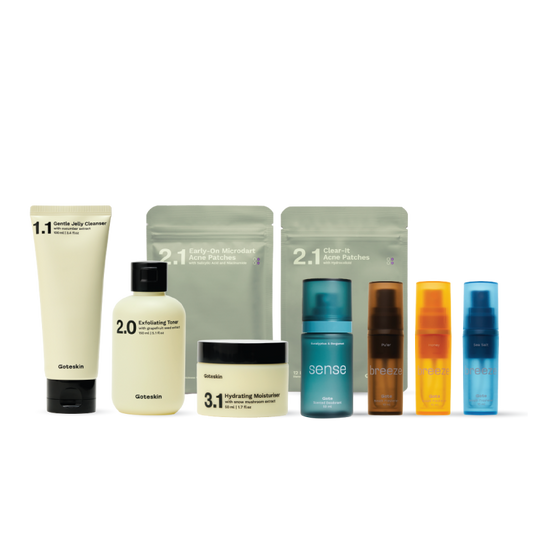
For what it's worth, this four-step structure is how our own skincare line is built: the Goteskin core is a gentle jelly cleanser, a gentle exfoliating toner, a hydrating moisturiser, and an oil-control sunscreen — with a small set of targeted treatments for specific concerns, not a 10-product system.

PERSONAL EXPERIENCE
How we apply this ourselves: Our skincare range is deliberately structured the way this article recommends: four core steps — cleanse, tone, moisturise, protect — plus a handful of targeted treatments (serums, acne patches) you'd only add for a specific, persistent concern. That structure isn't an accident. We've found the hardest part of skincare isn't choosing products. It's still being there on week six. Four steps survive week six. The 4-step basics .
When Does Adding More Steps Make Sense?
After the basics have been consistent for 6–8 weeks and you have a specific, persistent concern — not before. General dermatology guidance, including Cleveland Clinic's, puts skin cell turnover at roughly 28–30 days in adults ([Cleveland Clinic]), so any routine change needs at least 4–6 weeks before you can fairly judge it.
When you do add, add one active at a time. Niacinamide for oil and texture. Vitamin C for dullness. Retinol for fine lines. Introduce it slowly, patch test first, and give it its own 4–6 week trial before adding anything else. Why one at a time? Two reasons: if your skin reacts, you'll know what caused it, and you avoid the trap the Pediatrics researchers flagged — users unknowingly stacking the same active across three to five products.
That trap is easier to fall into than it sounds, because actives hide behind different marketing names on different labels. The skill that protects you is the same one that protects you from alcohol scaremongering: reading the ingredient list itself. Our guide on [how to read your ingredient labels] walks through the INCI list in about two minutes.
Treat this as the anti-overwhelm upgrade path: basics first, stabilize for 6–8 weeks, then add one thing. Persistent acne, suspected allergy, or sensitivity that doesn't settle is a dermatologist conversation, not a product-shopping problem.

What Does a Simple Routine Cost vs. a Viral One?
The viral routines in the Northwestern study averaged US$168 per month, and some exceeded US$500 ([CNN Health], 2025). That's roughly RM700 a month at the average — for routines that mostly skipped sunscreen. A 4-step routine costs a fraction of that, because you're buying four products on a multi-month replacement cycle instead of ten.
Now hold that against local reality: 41% of Malaysians spend under RM100 per month on personal care ([Statista], 2024). The gap between what influencers model and what people here actually spend isn't a gap you should feel guilty about. It's evidence that the influencer model was never built for your bathroom or your budget.
CITATION CAPSULE: Routine complexity is expensive without being protective. The viral teen routines analyzed in the June 2025 Pediatrics study averaged US$168 per month — some exceeding US$500 — while only 26% included daytime sunscreen; meanwhile 41% of Malaysians spend under RM100 monthly on personal care (Northwestern Medicine / CNN, 2025; Statista, 2024).
A brand has every incentive to tell you otherwise. We'll say it plainly instead: a skincare company recommending fewer products is arguing against its own interest, and we're comfortable with that, because customers with calm skin and money left over come back. Customers burned by an 11-active routine quit skincare entirely.

Frequently Asked Questions
1. Is a 10-step skincare routine really necessary?
No. The American Academy of Dermatology's core routine is three steps: gentle cleanser, moisturiser, and SPF 30+. Beyond the basics, extra steps add irritation risk faster than they add results — viral routines averaged 11 irritation-risk active ingredients, and only 26% included sunscreen (Pediatrics / Northwestern Medicine, 2025).
2. Can too many skincare products damage your skin?
Yes. Frequent use of multiple cosmetic products is a documented risk factor for contact dermatitis (Annals of Allergy, Asthma & Immunology, 2020). Stacking products also risks doubling up the same active unknowingly — the 2025 Pediatrics study found some users applying one active across three to five products in a single routine.
3. What's the most basic skincare routine I need?
Four steps cover it: a gentle cleanser morning and night, an optional hydrating toner, a moisturiser to support your skin barrier, and broad-spectrum SPF 30+ every morning. That matches the AAD's core guidance, with the toner added as a lightweight hydration layer suited to humid climates like Malaysia's.
4. How long until a simple skincare routine shows results?
Give it 4–6 weeks minimum. Skin cell turnover runs roughly 28–30 days in adults (Cleveland Clinic), so judging any routine sooner means judging skin that hasn't fully renewed yet. Consistency during that window matters more than the number of products — measured adherence to topical routines averages only ~40% (JAAD).
5. Do I need a toner in my skincare routine?
Dermatologists class toner as optional, so no — you don't strictly need one. But in humid climates, a gentle hydrating toner works as a lightweight hydration layer after cleansing, sometimes replacing heavier creams. Avoid harsh astringent toners entirely; with 71% of adults reporting sensitive skin (JEADV, 2020), they cause more problems than they solve.
The Verdict
You don't need a 10-step routine. The evidence says you need a routine you'll actually repeat — and that points to four steps, not ten.
The case against complexity is unusually consistent. Viral routines averaged 11 irritation-risk actives and mostly skipped sunscreen (*Pediatrics*, 2025). Multi-product use is a documented contact dermatitis risk factor. And the adherence research shows real-world consistency sits near 40%, not the 80–90% we believe — every extra step widens that gap.
So: gentle cleanser, a hydrating toner if your climate calls for it, moisturiser, SPF 30+. Run those four for 6–8 weeks before judging, then add one active at a time only if a specific concern persists. Consistency, not complexity, is the active ingredient.
And if a brand tells you healthy skin requires a 10-product system, remember who profits from that math. It isn't your skin.

Sources consulted:
- Northwestern Medicine — "TikTok teen skin care routines are harmful," June 2025, retrieved 2026-06-11, https://news.northwestern.edu/stories/2025/06/tiktok-teen-skin-care-routines-are-harmful
- CNN Health — "Teen skin care routines on TikTok are harmful, study says," June 2025, retrieved 2026-06-11, https://www.cnn.com/2025/06/09/health/tiktok-teen-skin-care-harmful-wellness
- Annals of Allergy, Asthma & Immunology — "Contact dermatitis associated with cosmetic product use," 2020, https://www.annallergy.org/article/S1081-1206(20)31080-2/fulltext
- PMC — "Adverse reactions to facial skincare products" (PMC6234074), 2018, https://pmc.ncbi.nlm.nih.gov/articles/PMC6234074/
- JEADV Clinical Practice — "Adherence to topical therapies," 2024, https://onlinelibrary.wiley.com/doi/full/10.1002/jvc2.379
- Journal of the American Academy of Dermatology — adherence electronic monitoring study, https://www.jaad.org/article/S0190-9622(05)03339-6/fulltext
- JEADV — "Sensitive skin meta-analysis (51,783 subjects)," 2020, https://onlinelibrary.wiley.com/doi/10.1111/jdv.16166
- YouGov UK — "UK skincare trends 2025: routines, multi-use products and what drives purchase," 2025, retrieved 2026-06-11, https://yougov.com/en-gb/articles/52964-uk-skincare-trends-2025-routines-multi-use-products-and-what-drives-purchase
- Euromonitor International — "Skincare sales set to reach USD 181 billion by 2025 as consumers are on a quest for skinimalism," 2024, retrieved 2026-06-11, https://www.euromonitor.com/article/skincare-sales-set-to-reach-usd-181-billion-by-2025-as-consumers-are-on-a-quest-for-skinimalism
- American Academy of Dermatology — "Skin care basics," retrieved 2026-06-11, https://www.aad.org/public/everyday-care/skin-care-basics/care
- Cleveland Clinic — "Skin: Layers, Structure and Function," retrieved 2026-06-11, https://my.clevelandclinic.org/health/body/10978-skin
- Statista — Malaysia monthly spending on personal care products, 2024, retrieved 2026-06-11, https://www.statista.com/statistics/1479646/malaysia-monthly-spending-on-personal-care-products/
Related Articles


