


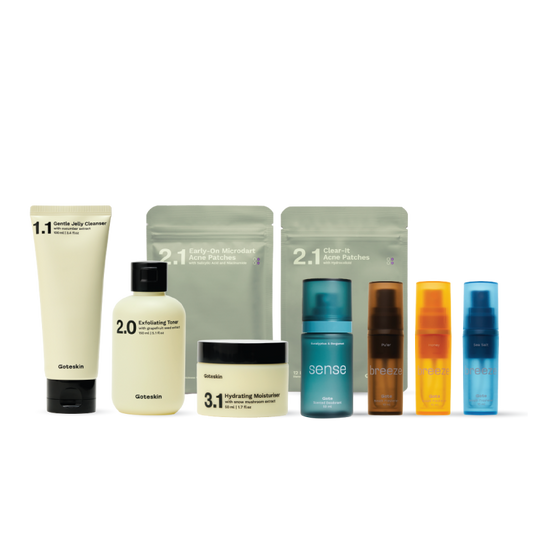



Sweat is odourless — bacteria are to blame. Sense Scented Deodorant in Eucalyptus & Bergamot kills odour-causing bacteria and keeps you fresh through Malaysia's heat.
How Sense Scented Deodorant Keeps Body Odour Away All Day

It's 8:45am. You're on the MRT, sandwiched between two strangers, and you're already sweating. By noon you'll have taken two buses and walked four hundred metres under direct sun. By 1pm you're at a hawker centre. By 7pm you've still got happy hour. That's not an unusual Tuesday in Kuala Lumpur. That's just your life — and it's a lot to ask of any deodorant.
Here's the thing most people get wrong: sweating isn't the problem. Sweating is healthy, normal, and necessary. The real culprit behind body odour is bacteria. Once you understand that, everything about how you choose a scented deodorant changes.
This post breaks down what actually causes body odour, how Sense Scented Deodorant works differently from what's already in your drawer, and whether the Eucalyptus & Bergamot variant matches your personality.
Key Takeaways
- Sweat is odourless — body odour is caused by bacteria converting sweat into sulfurous compounds ([University of York])
- Sense Scented Deodorant kills odour-causing bacteria without blocking sweat, supporting your body's natural cooling process
- Bergamot essential oil improved positive mood scores by 17% in a clinical study ([PMC / Phytotherapy Research] , 2017)
- Asia Pacific is the world's fastest-growing natural deodorant market at 15.5% CAGR — and Sense is built for exactly this climate
What Actually Causes Body Odour?
Sweat itself is completely odourless. Research from the [University of York] identified bacteria — specifically *Staphylococcus hominis* — as the real source of body odour. These bacteria convert sweat secretions into thioalcohols: sulfurous, pungent compounds that produce the smell we associate with a sweaty day ([Journal of Investigative Dermatology / ScienceDaily] , April 2024).
Your armpits have a high concentration of apocrine glands. These glands produce a protein-rich sweat that bacteria find particularly useful. The bacteria consume it. The byproduct is the smell. It's not a hygiene failure — it's just biology.
In Malaysia's heat and humidity, this process speeds up. Your body sweats more to cool down, and the warm, damp environment lets bacteria multiply faster. So if you've ever felt like your body odour is worse here than when you travel somewhere cooler, you're not imagining it.
UNIQUE INSIGHT
One thing worth knowing: if your deodorant seems to "stop working" after a few weeks of consistent use, the reason probably isn't that your body has adapted to the formula. It's more likely that a change in your routine — exercise patterns, diet, stress — has shifted your bacteria activity. That's why targeting bacteria with the right formula matters more than just switching brands.

Deodorant vs Antiperspirant — What's the Real Difference?
Consumer awareness is shifting fast. The global aluminum-free deodorant market was valued at USD 1.9 billion in 2023, and it's projected to reach USD 3.8 billion by 2030 at a CAGR of 10.2% ([GlobeNewsWire / Persistence Market Research] , January 2024). People are actively choosing deodorant over antiperspirant — and for good reason.
The difference is straightforward. An antiperspirant uses aluminum compounds to physically plug your sweat glands, stopping sweat from reaching the skin surface. It prevents sweating. For people with hyperhidrosis, that can be genuinely useful. But for everyday use, you're essentially blocking a natural body function.
A deodorant doesn't stop you from sweating. It targets the bacteria responsible for turning that sweat into odour. It works with your body, not against it. Sweating is how your body regulates temperature — particularly important in a climate where 32 degrees before lunch is completely normal.
Sense is a deodorant. It lets your body do what it's meant to do, while eliminating the bacteria that cause the smell. That distinction matters.
Asia Pacific is also leading this global shift. Natural deodorants in the region are forecast to grow at 15.5% CAGR between 2025 and 2030, with the market projected to reach USD 708.67 million by 2034 ([Grand View Research], [Deep Market Insights] , 2024–2025). This isn't a niche preference anymore. It's where the category is going.
The global aluminum-free deodorant market, valued at USD 1.9 billion in 2023, is on track to double to USD 3.8 billion by 2030 at a 10.2% CAGR ([GlobeNewsWire / Persistence Market Research] , January 2024). Asia Pacific is the fastest-growing region, forecast at 15.5% CAGR through 2030.
Meet Sense — What Makes It Different from Regular Scented Deodorants?
Scent isn't just a nice-to-have. A 2021 PLOS ONE study (n=94) found that fragrance on the body significantly raised observer ratings of both self-esteem and attractiveness, effectively masking the perceived gap between high and low self-esteem scent markers ([PLOS ONE] , November 2021). Smelling good changes how people read you. That's not vanity — that's confidence working in the background.
Most scented deodorants are built around fragrance as the solution. The logic is: if it smells good, you won't notice the odour underneath. Sense doesn't work that way. It kills the odour-causing bacteria first. The scent is the final layer — a finishing touch, not a cover-up.
This matters more than it sounds. When you're out for a full day, you want to know the problem is actually solved, not just temporarily masked. That's the difference between feeling confident on the bus and hoping nobody notices.
The Eucalyptus & Bergamot scent is bright and citrusy with a green, airy quality. It's refreshing without being loud. Light enough that it won't clash with the perfume you put on in the morning — it sits underneath your fragrance, not on top of it.
What does that look like in practice? A quick refresh after a hawker centre lunch, without needing to go home first. A reapply between showers on a day that started at the gym and ends at a rooftop bar. Something fast, effective, and unobtrusive.
PERSONAL EXPERIENCE

When you use it between showers or after a sweaty commute, the scent is light enough that it doesn't compete with whatever fragrance you've already got on. That balance is harder to get right than most deodorants manage — and it's the thing people notice most once they've tried it.
Why Eucalyptus & Bergamot?
The scent combination isn't random. A clinical study found that 15 minutes of bergamot essential oil exposure improved participants' positive affect scores by 17% compared to a water-diffusion control group in an 8-week trial at a mental health clinic waiting room (n=57) ([PMC / Phytotherapy Research] , 2017). And a 2025 study went further, identifying the exact neural circuit — from the anterior olfactory nucleus to the anterior cingulate cortex — through which bergamot reduces anxiety ([Advanced Science / Wiley] , 2025). Your morning scent is doing more than you realise.
Bergamot is bright and citrusy — the kind of scent that feels like stepping outside on a clear morning. Eucalyptus is green and cooling, with an airy quality that reads as clean without being clinical. Together they don't compete. They move in the same direction: energy, lightness, freshness without effort.
It's worth comparing this to the other Sense variant: Geranium & Sandalwood. That one is warmer and more sensual — built for slower moments, evenings out, weekends where you're not rushing anywhere. Eucalyptus & Bergamot is the opposite mood. It's for movement. The gym, the park connector, the morning market, the back-to-back meetings.
UNIQUE INSIGHT
Botanical scents tend to perform better in tropical climates because they're airy and light-dispersing rather than base-heavy and clinging. Heavy musks and woody notes can turn sharp when they heat up. Citrus and green scents open up instead — which is part of why this combination works so well in a Malaysia context, not just on paper.
Made for the Person Who's Always Moving
If you're out in the sun by 10am, on the MRT by noon, at a hawker centre by 1pm, and somewhere with good company by 7pm — Sense Eucalyptus & Bergamot was made for your day. It's the bergamot eucalyptus deodorant for people who don't slow down until they choose to.
If you prefer something warmer and more sensual, Geranium & Sandalwood is your match. But if you like your freshness bright, citrusy, and green — this is yours.
Frequently Asked Questions
1. Is Sense a deodorant or an antiperspirant?
Sense is a deodorant, not an antiperspirant. It doesn't block sweat glands or use aluminum compounds. Instead, it kills the bacteria that convert sweat into odour — letting your body sweat naturally while eliminating the smell. The global aluminum-free deodorant market is growing at 10.2% CAGR, reaching an expected USD 3.8 billion by 2030 ([GlobeNewsWire / Persistence Market Research] , January 2024).
2. Will Sense Scented Deodorant interfere with my perfume?
It's designed not to. The Eucalyptus & Bergamot scent is intentionally light — bright and citrusy, not heavy or musky. Research shows fragrance raises perceived attractiveness and self-esteem in observers ([PLOS ONE] (https://journals.plos.org/plosone/article?id=10.1371/journal.pone.0258773), November 2021), so Sense is built to complement your main fragrance, sitting underneath it rather than competing with it.
3. How long does Sense Scented Deodorant last in Malaysia's heat?
It's formulated for all-day freshness in hot, humid conditions. Bacteria thrive in heat and moisture, which is why Malaysia’'s climate creates a specific challenge for body odour. Sense targets the bacteria directly, rather than masking them with fragrance. Asia Pacific's natural deodorant market is growing at 15.5% CAGR precisely because consumers here need formulas built for this climate ([Grand View Research] (https://www.grandviewresearch.com/industry-analysis/organic-deodorant-market), 2024).
4. What's the difference between Eucalyptus & Bergamot and Geranium & Sandalwood?
Both are scented deodorants that kill odour-causing bacteria. The difference is mood and occasion. Eucalyptus & Bergamot is bright, citrusy, and green — built for active days and outdoor energy. Geranium & Sandalwood is warmer and more sensual, better suited to evenings or slower-paced days. Bergamot has been shown to improve positive affect scores by 17% in a clinical setting ([PMC / Phytotherapy Research] , 2017).
The Bottom Line
Body odour isn't a hygiene failure — it's a bacteria problem. *Staphylococcus hominis* converts your sweat into the compounds that smell. The right body odour deodorant targets those bacteria, not the sweat itself. Sense Scented Deodorant does exactly that.
The fact that Asia Pacific is now the fastest-growing natural deodorant region in the world — at 15.5% CAGR through 2030 ([Grand View Research] , 2024) — tells you the region's consumers have figured this out. They want something that works with their climate, not against their body.
If your days are active, your scent should match. Sense Eucalyptus & Bergamot is built for exactly that energy.
Related Articles


