





In Malaysia, acne affects 75.8% of students. Most treatments make it worse. Here's why harsh products fuel the cycle — and how to actually break it.
Why Your Acne Keeps Coming Back — And How to Break the Loop

You use a high-strength benzoyl peroxide. The pimple dies. Two days later, three more appear in the same spot. Your skin feels red and tight.
That's not bad luck. That's the Acne Loop.
In Malaysia, acne affects as many as 75.8% of young adults — well above the global average of 20.5% (, 2025; , 2024). Most of them are treating it the same way. And most of them are stuck in the same cycle.
This post explains why the loop exists. And the right sequence to break it.

Key Takeaways
- In Malaysia, acne affects 75.8% of young adults — well above the global average of 20.5% (Karger / Singapore-Malaysia Genetics Study, 2025)
- Harsh treatments strip skin barrier lipids, triggering more sebum and more breakouts — the Acne Loop
- Skin barrier dysfunction (elevated TEWL, disrupted filaggrin) is present in acne patients and worsened by over-treatment (PMC, December 2024)
- A salicylic acid + niacinamide formula reduced sebum by 23.65% and TEWL by 49.26% in 21 days (PMC, 2025)
- The fix: calm inflammation first, then target spots with Acne Patches — not whole-face aggression
"If stronger, harsher products were the answer, acne wouldn't be the number one complaint in our community. The problem isn't that you're not doing enough — it's that you're doing the wrong things first." — Han Pin, Founder, Goteskin
Why Does Acne Keep Coming Back in the Same Spot?
In 2025, a Singapore-Malaysia cross-sectional genetics study published by Karger found that 55.8% of acne cases were inflammatory phenotype — meaning most recurring breakouts aren't new infections. They're the same inflammatory cycle, repeating (, 2025).
That distinction matters. Most people treat a pimple as a single event. It isn't. It's a flare-up inside a follicle that has been structurally compromised. The follicle doesn't heal between flares. It just quiets down.
Once a follicle is inflamed, the surrounding tissue changes. The walls thicken. The pore narrows. Bacteria get better access to the sebum pooling underneath. You're not dealing with a new infection each time — you're dealing with the same site, firing again.
Acne is a chronic inflammatory condition. That's not a dramatic claim. It's the clinical framing. You wouldn't treat a chronic condition with a one-time intervention and expect it to stay gone. Yet that's exactly what most acne advice asks you to do.
Killing the pimple doesn't kill the cause. The inflammatory pathway stays open. Sebum production continues. The bacteria that feed on it don't disappear when the surface clears. A 21-day treatment cycle gives the impression of resolution. The follicle hasn't healed.
The same Karger study found that 38.5% of acne cases in the Singapore-Malaysia cohort were moderate-to-severe, and 52.8% of affected individuals had developed scarring. That's more than half. Scarring is not a cosmetic footnote — it's evidence that surface-level treatment isn't resolving what's happening underneath.
UNIQUE INSIGHT
Goteskin note: Most acne advice is written for temperate climates. In Malaysia, your skin is also managing 30-degree heat, 80% humidity, and four to five hours of air-conditioning per day. That thermal cycling — hot outside, cold inside, hot again — stresses and re-stresses the barrier in ways that Northern European skincare formulas were never designed to handle.
Citation capsule: In 2025, a Singapore-Malaysia genetics study (n=2,118 participants) found that 55.8% of acne cases were inflammatory phenotype and 52.8% of affected individuals had developed scarring — evidence that surface-level pimple treatment is not resolving the underlying inflammatory pathway (, 2025).
Is Harsh Skincare Actually Making Your Acne Worse?
In December 2024, a PMC review of skin barrier dysfunction in acne vulgaris confirmed that acne patients show significantly elevated transepidermal water loss (TEWL), disrupted filaggrin expression, and a complete absence of claudin-1 in the stratum corneum — all markers of a compromised barrier. Standard acne treatments can worsen all three (, December 2024).
Here's what that means in practice. When you apply a strong surfactant cleanser or a high-percentage acid, you remove the lipids that seal your skin. Those lipids are not decorative. They're functional. They keep moisture in and bacteria out. Strip them, and your skin responds by producing more sebum to compensate.
More sebum means more food for the bacteria that cause acne. A compromised barrier means those bacteria get easier access to the follicle. The result: you treat the pimple aggressively, you create conditions for more pimples to form. That's the Strip-and-Grease Cycle.
The same review noted that acne incidence reaches 93% in teenagers, and 37% of acne patients develop skin sensitivity as a complication. Between 3% and 7% experience scarring (, December 2024). The pattern is consistent: attack harder, get worse outcomes.
What about benzoyl peroxide? It works. That's not the argument. But at 10% concentration, it's not meaningfully more effective for most users than at 2.5% — and it's significantly more damaging to barrier function. The higher percentage worsens the same barrier markers already compromised in acne-prone skin.
The logic of "stronger must mean better" is what keeps people in the loop. You're not curing acne by applying harsher products. You're creating the conditions for it to thrive.
Citation capsule: In December 2024, a PMC literature review confirmed that claudin-1 — a tight junction protein critical for barrier integrity — is completely absent from the stratum corneum in acne patients, while elevated TEWL and disrupted filaggrin are present throughout. Applying additional chemical exfoliants or high-percentage actives to this already-compromised barrier accelerates the barrier damage that drives recurring breakouts (, December 2024).

What Is the Skin Barrier — And Why Does It Matter for Acne?
Your skin barrier is a lipid-protein matrix. It keeps moisture in and irritants out. When it's intact, acne bacteria can't easily access the sebum they need to multiply. When it's stripped, your skin becomes structurally vulnerable — and breakouts shift from situational to systemic.
Think of it like mortar between tiles. The tiles are your skin cells. The mortar is the lipid layer sealing the gaps. Remove the mortar and the wall looks fine from a distance. But water gets in. Everything behind it erodes.
TEWL is the measurable signal. Transepidermal water loss is the rate at which water escapes through your skin. When TEWL rises, your barrier is losing moisture faster than it can recover. In acne patients, TEWL is significantly elevated compared to healthy controls — even before any treatment is applied (, December 2024).
The claudin-1 finding is striking. Claudin-1 is a tight junction protein. It's what physically seals your skin against pathogens. In healthy skin, it's present throughout the stratum corneum. In acne-affected skin, it's completely absent. Not reduced. Gone.
In Malaysia, 30-degree heat and 80% humidity don't make your skin tougher. They compound the barrier stress. That's not a reason to use harsher products. It's exactly the reason not to.
The fix isn't to fight harder against your skin. It's to stop making the wall weaker.
Citation capsule: Claudin-1, a tight junction protein that seals the skin barrier against pathogen entry, is completely absent from the stratum corneum of acne patients — compared to healthy controls where it is consistently present. This structural gap means acne-prone skin is not just inflamed; it is physically more permeable to bacteria and environmental irritants (, December 2024).
How Do You Break the Acne Loop? The "Calm & Clear" Protocol
In 2025, a 21-day clinical study of 42 participants found that a salicylic acid formula combined with barrier-supportive ingredients (niacinamide and ceramides) reduced sebum by 23.65%, improved skin hydration by 40.5%, and cut TEWL by 49.26% — without worsening barrier function (, 2025). That's what calm-first treatment looks like.
The Calm & Clear Protocol runs in two phases. Phase one is not optional.
Phase 1 — Calm (reduce inflammation before treating the spot)
Niacinamide works by inhibiting poly(ADP-ribose) polymerase. That's the enzyme that activates the inflammatory cytokines IL-1 beta, IL-6, and TNF-alpha — the signals that keep the follicle inflamed (, 2024-2025). Block the enzyme, you interrupt the inflammatory loop at the source.
Centella asiatica works differently. It accelerates barrier repair, supports wound healing, and modulates the scar formation process through multiple molecular pathways (, 2025). It's not dramatic. It's structural.
Why does the sequence matter? Treating an inflamed, barrier-compromised pimple with a strong acid is like applying paint to a wet wall. The wall looks covered. The moisture underneath destroys the bond. And three days later, it peels.
Phase 2 — Clear (targeted treatment once inflammation is reduced)
Once inflammation is calmer, you treat the spot. Not your whole face — the spot. deliver salicylic acid locally while the hydrocolloid barrier stops the one thing that causes most post-acne scarring: touching.
[PERSONAL EXPERIENCE] From Han Pin: "When we were formulating the Acne Patch, we kept asking why every acne brand was competing to be harsher. The answer was they were optimising for the wow moment — the pimple that visibly dies. We were optimising for the month after that."
The 3-week timeline is based on the clinical study outcomes. It's directional, not a promise.
Citation capsule: In 2025, a 21-day clinical study (n=42) found that a barrier-supportive salicylic acid formulation achieved 23.65% sebum reduction, 40.5% hydration improvement, and 49.26% TEWL reduction — alongside a 23.81% improvement in Investigator's Global Assessment score. These results occurred without worsening barrier function, demonstrating that acne treatment and barrier repair are not mutually exclusive (, 2025).


How Do Gote Acne Patches Actually Work?
In 2024, a randomised controlled trial published in the Journal of the American Academy of Dermatology found that hydrocolloid patches produced statistically significant improvements in pimple size, texture, redness, and elevation within 1 to 4 days — compared to washing alone (, 2024). That's the clinical case for patches. Here's how the two-patch system works in practice.
Early-On Patches — for the bump you feel before you see it
The moment you feel a bump forming under the skin, that's the right time. Salicylic acid in the patch penetrates the pore wall before the pimple fully forms. The hydrocolloid creates a physical barrier between your fingertips and the spot.
That last part is underrated. Most scarring isn't from the acne itself. It's from the extraction that follows. The patch removes the temptation by covering the site visually.
Clear-It Patches — for active whiteheads
Once a whitehead has formed, the absorbent hydrocolloid core draws out the fluid inside. You see the result on the patch when you remove it — the collected exudate. It's the confirmation that something is working. More practically, it eliminates the need for manual extraction, which is the fastest route from a pimple to a scar.
Why patches outperform spot creams for most surface lesions: occlusion significantly improves ingredient penetration. The patch creates a moist, sealed microenvironment that keeps the active in contact with the skin. A spot cream applied and rubbed in? Most of it disappears within an hour.
There's an honest limitation here. Patches don't work for deep cystic nodules. If you can't feel a head forming, the nodule is deep and painful, and it's not responding after 2 to 3 days of surface treatment — see a dermatologist. That's the right intervention, not a stronger patch.
Citation capsule: In 2024, a randomised controlled trial in the Journal of the American Academy of Dermatology confirmed that hydrocolloid dressing patches produced statistically significant reductions in pimple size, redness, surface texture irregularity, and elevation within 1-4 days compared to a control group using washing alone. The mechanism: occlusion maintains a moist wound-healing environment that accelerates resolution without chemical aggression (, 2024).

What Routine Should Someone With Recurring Acne Actually Follow?
The global acne treatment market is projected to reach USD 11.1 billion by 2030. Recurrence rates remain high — not because the products don't work, but because most protocols optimise for short-term clearance over long-term barrier stability. The right sequence matters more than the right product.
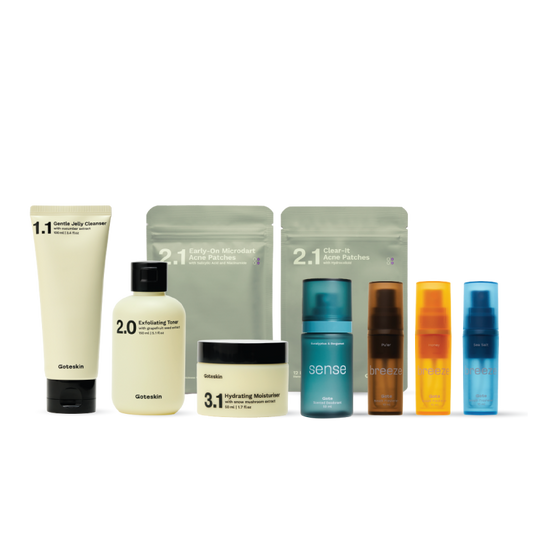
Here's what that sequence looks like, built around Goteskin's four-step system.
Step 1 —
Gentle Jelly Cleanser. No sodium lauryl sulfate. pH-balanced. It removes sweat, sunscreen, and daily grime without disrupting barrier lipids. Use it morning and night. Don't substitute it with anything that foams aggressively — foam is not a marker of cleanliness. It's a marker of surfactant concentration.
Step 2 —
Clear the pathway for actives. Unclogs pores. Prepares the skin surface for Step 3. Don't skip this step and don't stack additional exfoliants on top of it — the goal is one pass, not saturation.
Step 3 —
Pore Minimising Serum. Niacinamide and Tea Tree. This is the Calm phase in liquid form — targeting sebum overproduction and inflammatory signalling simultaneously. Apply before moisturiser so it reaches the skin directly.
Step 4 — SPF
UV exposure worsens post-inflammatory hyperpigmentation. Every acne scar you're trying to fade will darken faster without SPF. This step is non-negotiable, especially in Malaysia.

Spot treatment — only where you need it
on early-stage bumps. on active heads. These sit outside the four core steps. They're the targeted intervention layer — not a daily routine product.
In 2025, the clinical study combining salicylic acid with niacinamide found 95% participant satisfaction with oil control and measurable improvements across all key acne markers in 21 days (, 2025). Combining the pore-clearing acid with the anti-inflammatory works. The barrier stays intact.
The routine is four steps. The acne patches are the targeted intervention — only where you need them. That's it.
Citation capsule: In 2025, research combining salicylic acid with niacinamide — the core active approach in a barrier-first routine — achieved 95% participant satisfaction with oil control and measurable improvements across all key acne markers in 21 days. The finding confirms that combining a pore-clearing acid with an anti-inflammatory does not compromise the barrier when formulated correctly (, 2025).
Frequently Asked Questions
1. Why does my acne come back in the same spot every time?
Once a follicle is inflamed, the surrounding tissue changes structurally. The follicle doesn't fully heal between flares — it quiets down. In 2025, a Singapore-Malaysia genetics study found 55.8% of acne cases were inflammatory phenotype, confirming that most recurring breakouts are the same inflammatory cycle repeating, not new infections (, 2025).
[INTERNAL-LINK: why acne is a chronic condition → H2 1 of this post]
2. Is benzoyl peroxide bad for my skin barrier?
Benzoyl peroxide is effective. The concentration is what matters. At 10%, it's not meaningfully more effective for most users than at 2.5% — but it does significantly worsen the barrier markers already compromised in acne-prone skin. A December 2024 PMC barrier dysfunction review found elevated TEWL and absent claudin-1 in acne patients, conditions that high-percentage BP accelerates (, December 2024).
3. How long does it take to repair a damaged skin barrier?
Surface repair is measurable within 2 to 4 weeks. Full stabilisation takes 8 to 12 weeks. The 2025 PMC clinical study showed measurable improvements in TEWL, hydration, and sebum across a 21-day window using a barrier-supportive salicylic acid formulation. That's the floor, not the ceiling — the skin continues improving if the routine stays consistent (, 2025).
4. Can I use niacinamide and salicylic acid at the same time?
Yes. The 2025 PMC study used a combined formulation and achieved better outcomes than acid-only approaches in prior literature. They work on different mechanisms: salicylic acid clears pore debris and reduces sebum at the follicle level; niacinamide suppresses the inflammatory cytokines that keep the cycle running. They're complementary, not competing (, 2025).
5. Do acne patches work for cystic acne?
No. Hydrocolloid patches work for surface lesions and early-stage pimples where there's a defined head or a shallow bump. Cystic nodules sit too deep in the dermis for any surface patch to reach. The 2024 JAAD RCT confirmed patch efficacy for superficial lesions specifically. For cystic acne, see a dermatologist — that's the right intervention (, 2024).
The Sequence Is the Point
The problem isn't how hard you're treating. It's what you do first.
The Calm & Clear Protocol runs in two phases for a reason. Reduce inflammation first — niacinamide interrupts the cytokine loop, centella supports barrier repair. Then treat active spots with targeted acne patches, not whole-face aggression. Keep the barrier intact across all four routine steps, every day.
Most treatments skip Phase 1 entirely. They go straight to the aggressive active and wonder why the loop doesn't break. It doesn't break because you haven't addressed the structural conditions that keep it running.
The barrier is the starting point. Not an afterthought.
The routine. Sorted.

Related Articles


