





Only 11% of men moisturise daily. It's not laziness — it's sensory friction. Greasy creams, slow-drying formulas, and strong scents kill routines. Here's what actually works.
Why Most Men Quit Skincare (It's Not What You Think)

You bought the moisturiser. You used it for a week. Then one morning you were running late and skipped it. The next day felt like too much effort. By Day 10, the bottle was still on the shelf — but you weren't using it.
That's not a character flaw. That's sensory friction.
In 2024, CivicScience found that only 11% of men moisturise daily, compared to 32% of women (). The gap isn't explained by how much men care about their appearance. It's explained by how most skincare products are designed: for a climate and a sensory experience that doesn't work for men.
This post explains why. And what "invisible performance" actually means.
[INTERNAL-LINK: why skincare consistency matters long-term → Goteskin blog hub or routine guide]
Key Takeaways
- Only 11% of men moisturise daily, vs. 32% of women — the gap is a product design problem, not a motivation problem (CivicScience, 2024)
- The average habit takes 66 days to form, not 21 — most men quit during the highest-risk "Quitter's Window" in the first two weeks (Lally et al., UCL, 2010)
- 65.6% of men prefer oral over topical skincare products partly because topicals leave skin feeling oily (PMC, 2017)
- A non-greasy male-specific formula achieved 91% post-study continuation — including 40% of men who had never used moisturiser before (PMC, 2021)
- Reducing sensory friction (no grease, no stickiness, no film) converts "chore" into "habit"
"Men don't hate skincare — they hate inconvenience. If a product feels like a mask or takes too long to dry, it disappears from the routine. We made Gote 'invisible' because we know you have better things to do." — Han Pin, Founder, Goteskin
Why Do Most Men Quit Their Skincare Routine by Day 10?
In 2019, analysis of 800 million Strava user activities found that roughly 80% of new exercise habits are abandoned within the first two weeks (). Skincare follows the same pattern. The first few days run on novelty. After that, only products that cause zero friction survive.
This is the "Day 10 Wall." It's not motivation running out. It's friction overcoming inertia. Those are two different problems with two different fixes.
In 2023, a CeraVe/OnePoll survey of 2,000 US men found that only 35% wash their face daily and 33% have no skincare routine at all (). Most of those men still want to look well-groomed. They're not indifferent. They're friction-fatigued.
The cognitive cost of a routine that "feels wrong" is higher than most people realise. It's not that a greasy moisturiser is unbearable on its own. It's that on a rushed morning, anything that requires effort competes with a hundred other things — and loses. A product that feels wrong trains you to avoid it without you even noticing.
Men aren't failing to start routines. They're failing to get through the Quitter's Window: that high-risk period in the first two weeks when the novelty wears off and the product has to earn its place on your shelf. Understanding habit formation changes how you read that window — and we'll cover the science of that next.
UNIQUE INSIGHT
Goteskin note: In Malaysia, the Quitter's Window is accelerated by the climate. A product that feels acceptable in a 20°C Seoul apartment becomes unbearable on a 33°C commute. Most moisturisers were not designed for this. They were designed for the shelf test in a controlled environment, not for a man who's about to sit in traffic for 45 minutes.
CITATION CAPSULE: In 2019, analysis of 800 million Strava activities found that approximately 80% of new fitness habits are abandoned within the first two weeks — the highest-risk window for any new habit. Skincare routines follow the same pattern: novelty supports Day 1 through 7, but only products that cause zero friction survive the transition from motivation to automaticity ().
What Is the Science Behind Habit Formation — And Why 21 Days Is Wrong?
In 2010, a UCL study led by Phillippa Lally tracked 96 participants over 12 weeks and found that the average time to form a new daily habit is 66 days, with a range of 18 to 254 days (). The 21-day rule is not based on any study. It originated from a plastic surgeon's observation about phantom limb sensations in the 1960s and got repeated until it felt like fact.

Why does this matter for your skincare routine? Because most people design their habits as if they'll stay motivated for three weeks. The research says the window is closer to three months — with wide individual variation.
The Fogg Behavior Model, developed at the Stanford Behavior Design Lab, puts it clearly: behaviour happens when Motivation, Ability, and a Prompt all converge at the same moment. When a product is hard to use or unpleasant, the Ability score drops. When Ability is low, the behaviour collapses the moment Motivation dips. And Motivation dips every morning after Day 7. That's just biology.
So what's the real path to a permanent skincare routine? Not stronger motivation. It's reducing the Ability barrier to near zero. A product that takes 30 seconds and feels like nothing scores a 10 on Ability. A product that leaves a greasy film for 20 minutes scores a 3. The Day 10 Wall is the first Motivation dip. Products have to survive it on Ability alone.

CITATION CAPSULE: In 2010, a UCL study (n=96) found that the average time to form a new daily habit is 66 days, not 21. The range spans 18 to 254 days, meaning some people form habits quickly and others take most of a year. For skincare specifically, this means the product must carry the habit through Motivation dips using Ability alone: it has to be fast, frictionless, and invisible ().
Is Harsh or Greasy Skincare Actually Killing Your Routine?
In 2017, a clinical study of male cosmetic treatment patients found that 92.7% of men limited their topical skincare to three products or fewer, and gel formulations were strongly preferred — specifically because of their non-oily texture and fast absorption rate. The same study found that 65.6% of men would rather use an oral treatment than a topical one, partly because topical products left skin feeling oily (). That's a product design problem with a product design solution.
The Grease Factor
Products that don't absorb quickly in 32°C heat with 80% humidity don't just feel unpleasant. They leave a visible shine that carries through a meeting, a gym session, and dinner. That's not a sensory problem alone — it's a social cost. Men stop using the product because the product creates a visible problem.
The Sting Factor
Products with high-alcohol formulas or poorly pH-balanced active ingredients interact with sweat. Sweating opens pores. In Malaysia's climate, with constant outdoor-to-indoor transitions, sweat exposure starts within minutes of application. A product that stings when sweat hits it conditions men to associate skincare with discomfort. That conditioning works fast, and it's hard to undo.
The Fragrance Factor
Overwhelmingly floral or "spa" scents are the default in most facial skincare. In 2023, the CeraVe/OnePoll survey of 2,000 US men found that only 19% moisturise regularly, with product experience cited as a key barrier alongside inconvenience (). A routine that smells like it was designed for someone else doesn't invite repetition.
The Environmental Multiplier
In Malaysia, all three friction factors are amplified. The average outdoor temperature exceeds 30°C for most of the year. Air-conditioning swings create rapid temperature changes. The skin is never in a stable, controlled environment.
Products designed for European or North American conditions — where skin has hours to dry down after application — don't perform the same way here. The formula that passes a controlled lab test fails a 33°C commute.
CITATION CAPSULE: A 2017 clinical study found that 92.7% of men cap their skincare at three products or fewer, and gel formulations are consistently preferred for their non-oily texture and fast absorption. 65.6% of men would rather use oral treatments than topicals, partly because topicals leave skin feeling oily — an effect amplified in high-heat, high-humidity environments ().
What Does "Invisible Performance" Actually Mean?
In 2021, a pilot study of a male-specific hydrating antioxidant formula published in the Journal of Cosmetic Dermatology found that 100% of participants reported the product absorbed well and left no greasy feel. 91% said they would continue using it after the study ended — and 40% of those participants had never used a moisturiser before the study began (). Non-greasy feel was the deciding factor for first-time moisturiser users. Not efficacy claims. Not packaging. Texture.
30-Second Sink-In
A formula built around a fast-absorption matrix disappears into skin within 30 seconds. No film. No shine. No stickiness. The standard test is simple: does the product leave anything visible on the back of your hand 60 seconds after application? If yes, it fails in Malaysian heat.
Matte Finish Without Dehydration
"Matte" is not the same as "dry." A good matte formulation uses a lightweight emulsion with niacinamide to control sebum output without stripping barrier lipids. You get the hydration of a moisturiser and the appearance of wearing nothing. That's the target: invisible results, zero trace of effort.
Gym-Ready Formulation
For men who train, sweat interaction is not optional. A product has to stay in the skin, not migrate into the eyes when the heart rate goes up. This means no high-alcohol compounds that volatilise under heat, and no fragrances that intensify as they interact with sweat.
[PERSONAL EXPERIENCE] From Han Pin: "Men don't hate skincare. They hate inconvenience. If a product feels like a mask or takes too long to dry, it disappears from the routine. We designed Gote's absorption profile specifically so it would pass a 32°C commute test, not a lab bench test."
CITATION CAPSULE: A 2021 pilot study published in the Journal of Cosmetic Dermatology found that 100% of male participants reported a male-specific hydrating formula absorbed well and left no greasy feel. 91% said they would continue using it after the study concluded, including 40% of participants who had never previously used a moisturiser. Non-greasy texture was the primary factor enabling first-time adoption ().

What Does a Men's Skincare Routine Actually Need to Look Like?
In 2024, facial skincare adoption among men reached 52% in the US — a 68% increase from 31% in just two years. Among Gen Z men specifically, 68% now use facial skincare (). The market is shifting fast. The question isn't whether to have a routine. It's how to build one that doesn't feel like one.

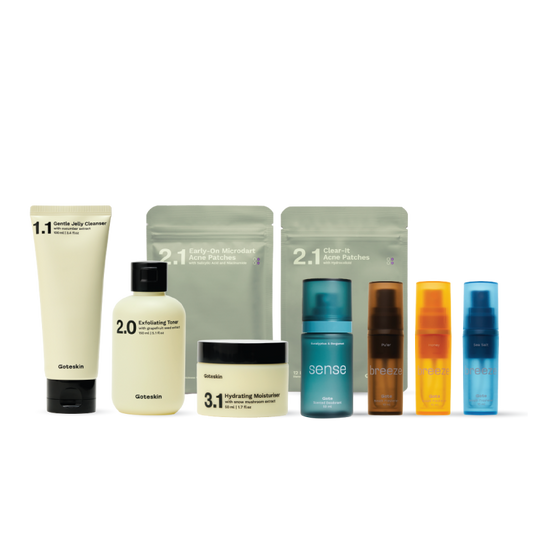
Step 1: A Cleanser That Doesn't Leave Your Face Feeling Tight
. No SLS. pH-balanced. Rinse it off and your face feels clean, not stripped. That's the test. If your cleanser leaves skin tight or dry, it's already starting the friction cycle before you've applied anything else.

Step 2: Exfoliating Toner After Cleansing
clears the pathway for everything that comes next. It unclogs pores and applies fast. No cotton pad required: tap it in. Done in seconds.

Step 3: Fast-Absorbing Serum for Pore Control and Calm Skin
. Niacinamide plus Tea Tree. Goes on like water. Dries like nothing. It controls sebum and reduces inflammation — the two things that make skin shiny and reactive in Malaysian heat.

Step 4: SPF
One product. Done in under 90 seconds total. UV exposure compounds every skin concern: acne scars, uneven tone, premature ageing. The number makes it non-negotiable. You don't debate whether to do Step 4. You just do Step 4.

The time reality: four steps, under 90 seconds. If a step takes longer than that, something is wrong with the product, not the routine.

CITATION CAPSULE: In 2024, Mintel found that facial skincare adoption among US men reached 52%, up 68% from 2022, with Gen Z men at 68% adoption. The fastest-growing segment uses simple, fast routines with minimal products. Asia Pacific men's grooming reached USD 3.67 billion in 2025 at a 4.98% CAGR, with skincare the dominant segment (; ).
How Do You Actually Make a Skincare Routine Stick?
In 2010, UCL researchers confirmed that habit formation is most reliable when a behaviour is anchored to an existing cue — a specific time, place, or preceding action — rather than motivation alone (). For skincare, this means the routine has to attach to something you already do. Not to a separate act of will, and not to a resolution.
Stack It onto Something That Already Exists
Teeth brushing. Shower. Getting dressed. Your skincare goes after one of those, every time, without exception. Location matters too. Products on the shelf get used. Products in a cabinet need to be retrieved — that retrieval is friction, and friction compounds over time.
Remove the Decisions
The numbered system (1, 2, 3, 4) removes decision fatigue entirely. You don't choose what to apply next. The number tells you. In 2017, the PMC study found that 92.7% of men already cap themselves at three products voluntarily. A four-product numbered system sits at the outer edge of what men will actually maintain — and it works precisely because every step is self-explanatory ().
Expect the Quitter's Window
Days 7 to 14 are the highest-risk period. You already know this now. Knowing it acts as a cognitive buffer: when Day 10 arrives and you don't feel like it, you can recognise the pattern instead of reading it as failure.
You don't need the routine to feel good on Day 10. You just need to do it anyway. The average habit forms around Day 66. Day 10 isn't even the midpoint. It's barely the beginning.

CITATION CAPSULE: In 2024, a PMC study (n=124) confirmed statistically significant differences (p<0.001) between men and women on routine adherence — men were substantially less likely to moisturise regularly or wash their face after exercise. The gap is explained by product experience barriers, not intrinsic disinterest. A 2021 PMC pilot study showed that 40% of men who had never used a moisturiser before maintained use when given a non-greasy formulation (; ).
Frequently Asked Questions
1. Why do most men give up on skincare after a few weeks?
In 2010, UCL researchers found the average habit takes 66 days to form, not 21 days. Most men quit during the Quitter's Window (days 7 to 14) because sensory friction — greasy residue, slow absorption, overwhelming scent — makes the product feel like a burden rather than a routine. Motivation runs out before automaticity kicks in ().
2. How many products do men actually need in a skincare routine?
A 2017 clinical study found that 92.7% of men voluntarily cap their topical skincare at three products or fewer. Four is workable when a numbered system removes decision fatigue. One product that feels wrong, or one that does nothing visible, is enough to collapse the whole routine ().
3. Why does skincare feel greasy when I sweat?
Most moisturisers use formulations optimised for temperate climates. They're designed to absorb over 10 to 20 minutes in a controlled environment. In Malaysia's 32°C heat, products that haven't fully absorbed interact with sweat, creating the sticky-oily feel. Fast-absorption gel formulas tested specifically for non-greasy finish avoid this entirely ().
4. How long does it actually take to form a skincare habit?
The average is 66 days, based on a UCL study of 96 participants, with a range of 18 to 254 days. The "21-day rule" you've probably heard is not based on published research. Plan for 8 to 10 weeks before the routine feels automatic. The first 14 days are the highest-risk period. Expect it, and don't treat a skipped day as a reason to quit ().
5. Is the men's skincare market actually growing in Malaysia?
In 2025, Malaysia's beauty and personal care market is projected to reach USD 3.7 billion by 2026, with men's grooming listed as a key long-term growth driver (). Asia Pacific men's grooming reached USD 3.67 billion in 2025 at a 4.98% CAGR, with skincare as the dominant product category at 37.98% market share ().
The Real Problem Was Never You
Quitting isn't the problem. Friction is. Remove the friction, and the habit forms itself.
Most skincare products were not designed for men in Malaysian heat. The product experience is the barrier, not the motivation. A routine that takes under 90 seconds and leaves no trace is the only routine that competes with everything else in your morning.
The science is settled: habits form around Day 66, not Day 21. The first two weeks are the hardest. And the single most reliable way to survive them is a product that costs you nothing: no residue, no sting, no time, no second-guessing.
The routine. Sorted.

Related Articles


